

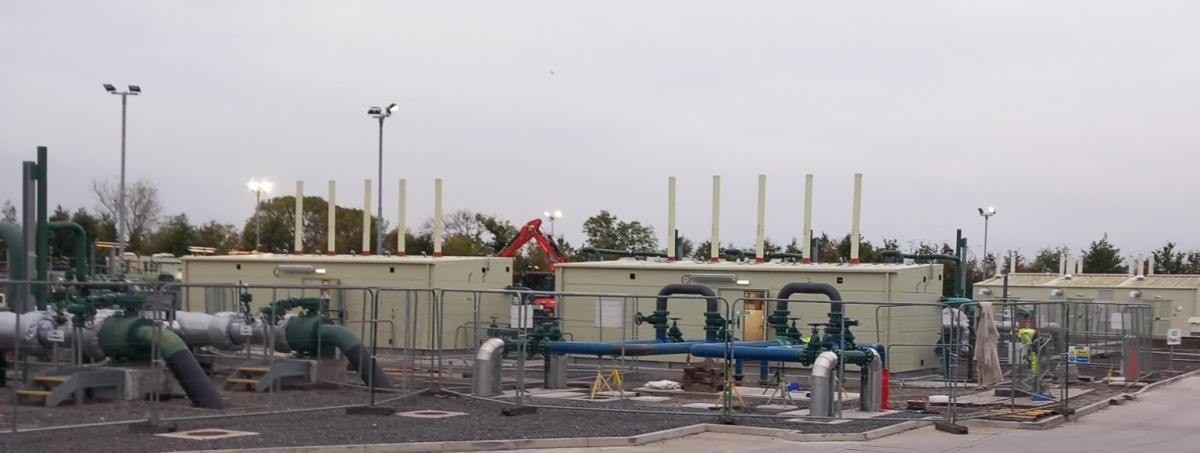
Armstrong Industrial’s expansion of boiler capacity at an Irish gas interconnector highlights the safety requirements involved in operating and upgrading critical energy infrastructure.
Armstrong Industrial has supplied two additional 3MW boiler houses at an Irish gas interconnector, increasing the site's stated heating capacity from 9.5MW to 15.5MW. The boilers pre-heat incoming gas before pressure reduction, supporting an increase in the interconnector's stated capacity from six million to 6.9 million standard cubic metres of gas per day. The project was reported by Impeller.
Armstrong Industrial is a division of Armstrong Fluid Technology providing industrial heating and process solutions, including packaged boiler systems for complex operating environments.
The installation involved integrating the two new boiler houses with two existing Armstrong units supplied in 2022 and the site's master control panel. The units were designed, built, tested and commissioned on a fast-track programme, with commissioning completed in October 2025 ahead of the planned increase in gas flows.
The health and safety significance lies in the controls required when additional combustion equipment is introduced into critical gas infrastructure. Armstrong says the new installation uses low-NOx condensing boilers, with condensate neutralised to a pH of 6 to 8 before discharge. During commissioning, gas valves are adjusted to achieve the boiler manufacturer's recommended carbon dioxide setting, with the resulting levels recorded.
These measures sit alongside the wider requirement to maintain safe operating conditions when gas is being heated before pressure reduction. The process is designed to keep the gas outlet temperature above 2°C following pressure reduction, with boiler output modulated according to the required load.
For health and safety teams, the project illustrates why safety cannot be treated separately from plant design and commissioning. Changes to process heating capacity can affect combustion systems, controls, emissions, temperature management and equipment interfaces, requiring these elements to be considered together before additional capacity becomes operational.
The integration with the existing master control panel is also significant. Adding new equipment to an established installation creates additional interfaces that need to operate predictably, particularly where the equipment supports a critical process rather than a discretionary building service.
The project also demonstrates the importance of commissioning as a safety control. Armstrong's delivery process included factory inspection, transport to site and commissioning by its service team, allowing the new equipment to be tested before being brought into the operating system. The company received the tender request in October 2024, secured the purchase order in February 2025 and completed manufacturing before September delivery.
The wider significance extends beyond the individual boiler houses. As critical infrastructure operators increase capacity, new equipment must be introduced without undermining established safety controls, environmental requirements or operational procedures. This makes design assurance, integration testing, commissioning and ongoing monitoring important parts of infrastructure resilience.
The project does not demonstrate that the new system has eliminated operational risk, and the safety measures described are primarily Armstrong's account of the installation. However, it provides a practical example of how safety considerations are embedded into the design and commissioning of industrial heating equipment supporting a critical national asset.
For the sector, the lesson is direct: increasing capacity in critical infrastructure also increases the importance of integrated safety management. As new plants are added to existing systems, combustion controls, emissions management, commissioning and equipment interfaces must be managed as part of one operational safety framework.
Source: Impeller / Engineer Live / Armstrong Fluid Technology












.png)
