

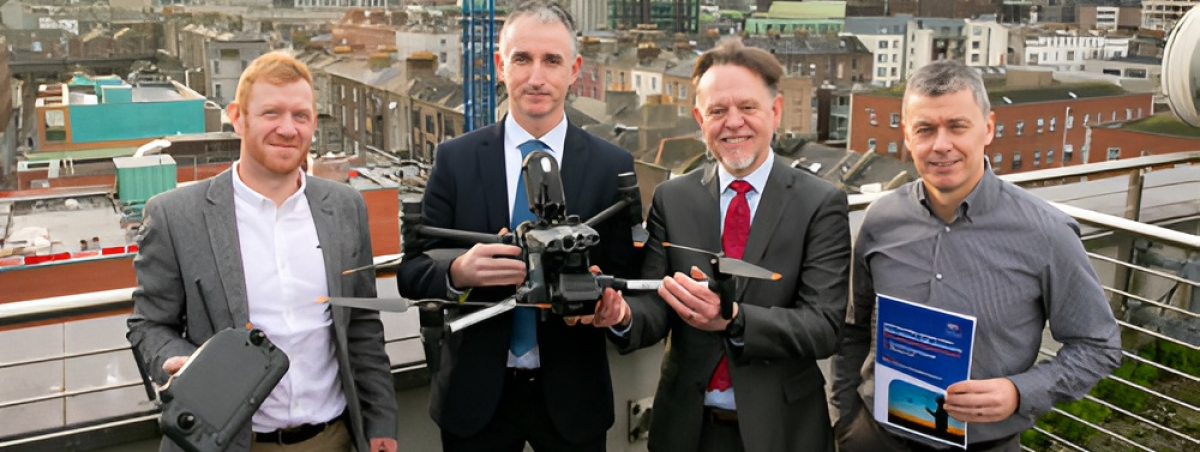
The Health and Safety Authority’s deployment of drone technology in workplace incident investigations marks a meaningful advance in Irish occupational safety enforcement. On 29 January 2026, the HSA formalised a Memorandum of Understanding with AirNav Ireland, enabling trained drone pilots to operate within controlled Irish airspace at incident scenes. The agreement gives investigators aerial access to hazardous or inaccessible locations, strengthening incident analysis and the data that informs prevention.
This development deserves a positive reading by Irish employers. Drone-enabled investigation produces better evidence about how incidents occur, which generates more accurate prevention guidance. The HSA’s investment in aerial capability reflects a regulator focused on understanding root causes rather than assigning penalties. Three implications flow from the agreement: a higher evidentiary standard for serious incident files, a stronger basis for prosecution where warranted, and a richer dataset from which Irish workplaces can draw lasting prevention lessons.
Drone technology gives HSA inspectors a capability ground-level access cannot replicate. From above, investigators can map the spatial context of an incident — the relationship between plant, personnel routes, edge conditions and exclusion zones — without entering hazardous areas. HSA CEO Mark Cullen noted that drones allow investigators to capture high-quality aerial evidence quickly and safely, particularly at locations inaccessible to ground inspectors. AirNav Ireland provides short-notice flight clearances, enabling rapid deployment at serious and fatal accident scenes.
The MOU builds on sustained HSA enforcement activity. The 2024 Annual Report recorded 11,600 workplace inspections underpinned by a 2025–2027 strategy prioritising evidence-led enforcement. The HSA’s 2026 Programme of Work targets the highest-risk sectors with unannounced inspections and aerial evidence gathering. Employers with strong safety management systems are well placed to welcome that scrutiny; those systems are precisely what the enhanced investigation process is designed to validate.
The practical implication for Irish employers is constructive: conditions visible from the air carry the same evidentiary weight as those observed at ground level. Edge protection, traffic management, exclusion zones and equipment storage are legible from drone footage. Organisations operating to a high standard will find aerial inspection confirms what their safety systems already demonstrate, while EU-OSHA research confirms visible controls reduce incident frequency independently of enforcement activity.
Three practical steps help Irish employers align with the new environment. First, conduct an aerial audit of each operational site internally or through a safety consultant, identifying conditions visible from above not routinely captured in ground-level inspection. Second, update safety statements to ensure edge protection, segregation barriers and exclusion zone markings meet the standard at which they would be assessed from the air. Third, benchmark internal incident investigation processes against the evidentiary standard the HSA now applies.
The HSA’s drone agreement with AirNav Ireland signals a regulator investing in tools that produce genuine understanding of how incidents occur and how to prevent them. For employers the message is affirming: organisations that maintain standards because they protect people, and not merely because an inspector might arrive, will find the enhanced investigation capability entirely consistent with how they already routinely operate.
(The views expressed by the writer are his/her own and do not necessarily reflect the views or positions of BusinessRiver.)






.png)
