

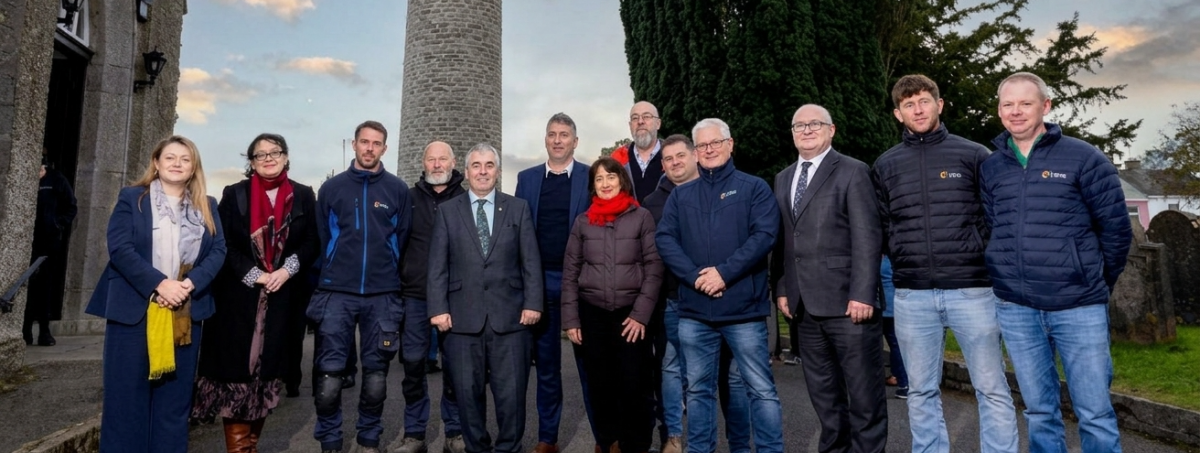
The Office of Public Works (OPW) has completed conservation works at Kells Round Tower in County Meath, demonstrating how rigorous health and safety planning can support the restoration of historic structures in active public spaces. The project combined specialist scaffolding, pedestrian protection and traditional stonework to preserve a national monument beside a footpath and graveyard.
Work began after scaffolding was erected in February 2024. Because the 26-metre tower stands close to public routes and a historic graveyard, the site required fully boarded scaffolding, a pedestrian walkway or gantry, access stairs, vehicular access, a crash deck and public lighting before conservation could proceed. The OPW announcement, reproduced by Building Ireland, details the safety arrangements needed to facilitate the work.
The project addressed long-term mortar loss and stone erosion while retaining the tower's historic character. OPW National Monuments craft workers from the Trim District, including stonemasons trained in traditional methods, carried out vegetation removal, localised repointing, stone cleaning, repair and consolidation. A removable steel floor was also installed at entrance level to facilitate future maintenance access without substantially altering the monument.
The scaffolding requirements reflect the importance of planning for both workers and the public when construction takes place in constrained environments. The original public procurement notice on eTenders specified fully enclosed external scaffolding, traffic management, a lit pedestrian gantry and lightning protection. These provisions formed part of the access solution for a structure positioned partly beside the street and partly within the graveyard.
The project also involved specialist access contractor PHD Access, whose project record describes the scaffolding solution used to enable conservation work at the tower's upper levels. The company provides access scaffolding for restoration and other complex projects, illustrating the role of specialist contractors in enabling skilled trades to work safely on sensitive structures. The completed conservation programme preserves the tower in its existing roofless form, consistent with the principle of minimal intervention.
For facilities managers, construction contractors and public asset owners, the project demonstrates how safe access, public protection and conservation requirements can be integrated from the outset. Its approach offers a practical example of planning temporary works around site constraints while protecting both heritage fabric and public movement.
For the sector, the lesson is direct: successful conservation depends on more than specialist craftsmanship. Thorough access planning, robust public-protection measures and skilled delivery enable complex restoration work to progress while safeguarding workers, visitors and Ireland's architectural heritage.
Source: fundsforNGOs News / Building Ireland / eTenders / PHD Access







.png)
