


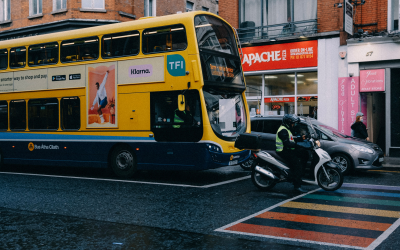
Public transport is one of Ireland's most significant frontline working environments, and the data now available about safety on that frontline demands a constructive and structured response. The National Transport Authority's Public Transport Passenger Personal Security Report 2025 confirms that the overwhelming majority of public transport journeys are completed safely, a baseline that reflects the professionalism and resilience of the transport workforce. But the same report finds that almost half of users have felt unsafe on public transport at least once, 82% have witnessed anti-social behaviour, 15% have experienced verbally aggressive behaviour, and 10% have experienced physical aggression. For Labour Councillor Pádraigh Reale and Conor Sheehan TD, who have called for Limerick to be designated as a regional pilot for a public transport safety programme, these figures are not a reason for alarm. They are a reason for action, and the proposals they are advancing point toward exactly the kind of evidence-based, regionally grounded safety programme that can produce measurable improvement in both passenger confidence and worker protection.
The occupational health and safety dimension of this debate is central and should be named explicitly. Bus drivers, train conductors, and transport station staff are workers operating in public-facing environments with limited physical protection, exposure to unpredictable interpersonal risk, and significant potential for both physical injury and psychological harm from repeated exposure to aggressive or threatening behaviour. Under the Safety, Health and Welfare at Work Act 2005, employers including public transport operators carry a duty of care to protect their workers from workplace violence and aggression, including verbal abuse, threats, and physical assault. The HSA's guidance on dealing with workplace violence and aggression identifies risk assessment, environmental design, lone worker protocols, and post-incident support as the core elements of a compliant employer response. A public transport policing model of the kind proposed by SIPTU, based on the Airport Police framework and supported by the NBRU, would strengthen the institutional safety management architecture within which those employer obligations can be more effectively discharged.
The Limerick regional pilot proposal is a particularly positive and practical initiative. Deputy Sheehan's observation that buses have been withdrawn from routes in Limerick because drivers have experienced anti-social behaviour is a concrete illustration of how safety failures on public transport create a compounding effect: reduced service coverage, increased worker stress, diminished public confidence, and ultimately lower public transport uptake, undermining the modal shift objectives that Ireland's National Sustainable Mobility Policy is specifically designed to achieve. A properly resourced regional pilot, combining visible security presence, additional surveillance, enhanced enforcement powers for authorised officers, and a structured worker safety programme, would generate the evidence base needed to scale effective interventions nationally while demonstrating that Ireland treats its public transport workforce as the essential workers they are.
Three actions would strengthen the public transport safety programme that Cllr Reale and Deputy Sheehan are advocating. First, the NTA and the relevant transport operators should commission a workplace violence and aggression risk assessment specifically for high-incidence routes and locations in Limerick, using HSA guidance on workplace violence as the assessment framework and engaging directly with frontline transport workers whose experience provides the most operationally accurate picture of where safety management interventions are most urgently needed. Second, transport employers should implement structured post-incident support programmes for workers who have experienced verbal or physical aggression, including access to occupational health counselling and employee assistance services, ensuring that the psychological impact of workplace violence is treated with the same seriousness as physical injury and that mental health in the workplace considerations are embedded in transport sector safety culture. Third, the Department of Transport should use the Limerick pilot proposal as the foundation for a national public transport worker safety framework, drawing on the SIPTU model for a National Public Transport Police Service and the NBRU's enforcement proposals to create a consistent, enforceable standard of worker protection that applies across all Irish public transport operators and gives frontline staff the confidence that their employer and the state take their safety seriously.
Safer public transport is not only a passenger experience objective. It is an occupational health and safety imperative for the thousands of workers who make Ireland's public transport system function every day. The NTA report, the Limerick pilot proposal, and the union-backed policing model together provide the evidence, the political will, and the structural framework to make meaningful and lasting progress on one of Ireland's most visible frontline safety challenges.






.png)
