

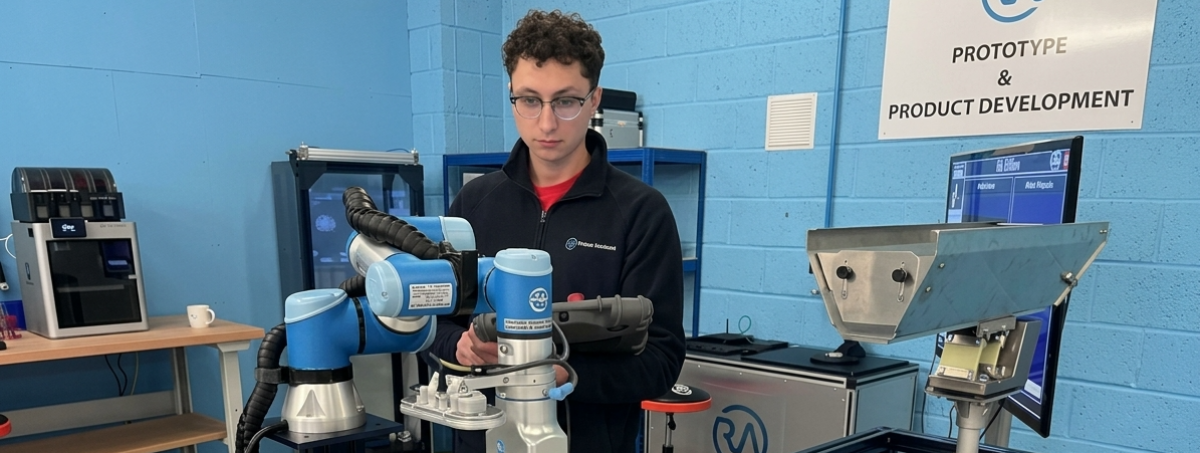
For Irish manufacturers, production automation is increasingly creating an opportunity to improve workplace safety alongside efficiency. Changeovers are a significant source of production loss, but they can also involve repeated manual intervention, equipment adjustments and physical handling. As manufacturers introduce more flexible automation, the opportunity is to redesign these activities around safer, more controlled ways of working.
A recent Engineers Ireland report on changeover automation highlights research showing changeover activities accounted for 37% of the decrease in OEE in the cited manufacturing analysis. The report focuses on FlexiBowl®, a flexible parts-feeding platform supplied and integrated in Ireland by Reliance Automation. Its ability to handle different part families without dedicated tooling illustrates how technology can reduce the amount of physical retooling required when production changes.
That has a clear Health & Safety implication. Where automation can reduce repetitive handling, manual adjustments and unnecessary intervention around production equipment, manufacturers have an opportunity to remove or reduce some sources of physical exposure. The Universal Robots marketplace specification for FlexiBowl confirms that one system can handle part families between 1–250mm and 1–250g, supporting multiple product changeovers within the same shift. The safety benefit, however, comes from how the complete cell is designed, safeguarded and operated rather than from the feeder alone.
This makes safety-by-design increasingly important for Irish manufacturing. Reliance Automation says its integrated approach brings component selection, robotic integration, vision systems, commissioning, risk assessment and safety documentation into the same engineering process. That is a valuable direction for manufacturers because safety should be considered alongside productivity and equipment performance from the earliest stages of automation design, rather than treated as a separate requirement once a system has been built.
The wider opportunity is to use automation to improve the quality of work as well as the performance of production lines. Moving employees away from repetitive physical tasks can allow greater focus on supervision, quality, process control and higher-value activities, while integrated systems can provide more consistent operating conditions. For Health & Safety leaders, this creates a practical opportunity to work more closely with engineering and operations teams when new technology is being specified, ensuring that productivity improvements and worker protection develop together.
The sector takeaway is clear: the next generation of manufacturing safety can be designed into the production system itself. Flexible automation gives Irish manufacturers an opportunity to reduce unnecessary manual intervention while improving operational performance, but the strongest results will come when risk assessment, safeguarding, training and human factors are built into the solution from the start. For H&S professionals, that makes automation not simply a technology investment, but an opportunity to create safer and more sustainable ways of working.






.png)
