

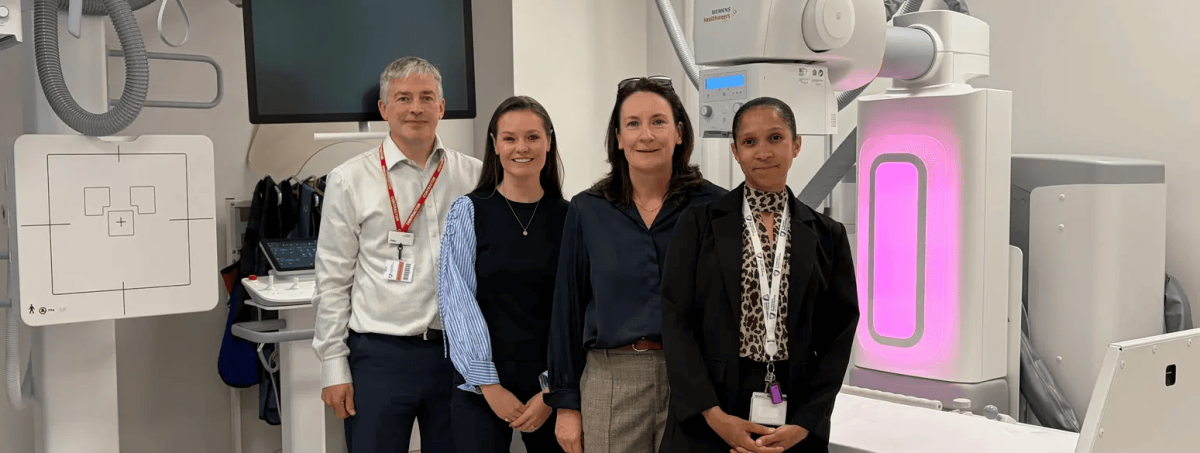
Ireland’s first installation of a new fluoroscopy system highlights how planned medical technology investment can support safer imaging workflows and long-term healthcare facility management.
St Vincent’s Private Hospital has become the first hospital in Ireland to install Siemens Healthineers’ LUMINOS Q.namix R fluoroscopy system, combining fluoroscopic and radiographic imaging within a single platform. The installation forms part of a 10-year Value Partnership between the hospital and Siemens Healthineers covering technology investment, maintenance and lifecycle management.
For health and safety professionals, the development is relevant because fluoroscopy environments require careful management of patient positioning, staff movement and radiation exposure. The LUMINOS Q.namix R platform is designed to support transitions between fluoroscopy and radiography while providing workflow guidance and large displays intended to improve visibility during examinations.
Radiation protection is an important consideration in any fluoroscopy environment. The HSE's radiation protection guidance for healthcare workers outlines the legislative framework, responsibilities and safety measures governing the use of medical radiation in Ireland. For clinical teams, equipment design therefore sits alongside established procedures for managing occupational and patient exposure.
The new system is also intended to support more efficient examination workflows. Siemens Healthineers says the platform provides built-in workflow guidance, large touch monitors and low-dose imaging capabilities, while allowing operators to move between fluoroscopic and radiographic examinations. These are manufacturer-stated capabilities rather than evidence of a quantified reduction in exposure at St Vincent’s.
Patient and staff safety also depend on how imaging equipment is operated within the wider examination environment. International guidance from the IAEA on radiation protection in fluoroscopy emphasises measures including minimising fluoroscopy time, maintaining appropriate distance from radiation sources and using shielding where required.
The 10-year Value Partnership provides an additional facilities-management dimension. Rather than treating specialist imaging equipment as a one-off capital purchase, the arrangement incorporates planned investment, maintenance and lifecycle management. This can help healthcare organisations align equipment renewal with changing clinical demand and operational requirements.
For healthcare facilities teams, the approach also demonstrates the growing connection between clinical technology and building operations. Specialist imaging systems require appropriate examination spaces, electrical infrastructure, maintenance arrangements and safety procedures, meaning equipment procurement can have implications well beyond the clinical department itself.
The investment could also support more flexible use of imaging capacity by bringing multiple capabilities together on one platform. Where equipment can accommodate different examination types within the same environment, healthcare providers can potentially improve utilisation of specialist rooms while maintaining appropriate clinical and safety controls.
For the sector, the St Vincent’s installation highlights how medical technology investment can support safer and more efficient clinical environments when it is considered alongside radiation protection, workflow design and lifecycle management. For health and safety professionals, the wider lesson is that equipment procurement, clinical engineering and facilities management need to work together to maintain safe conditions for patients and staff.
Source: Siemens Healthineers / HSE / IAEA












.png)
