

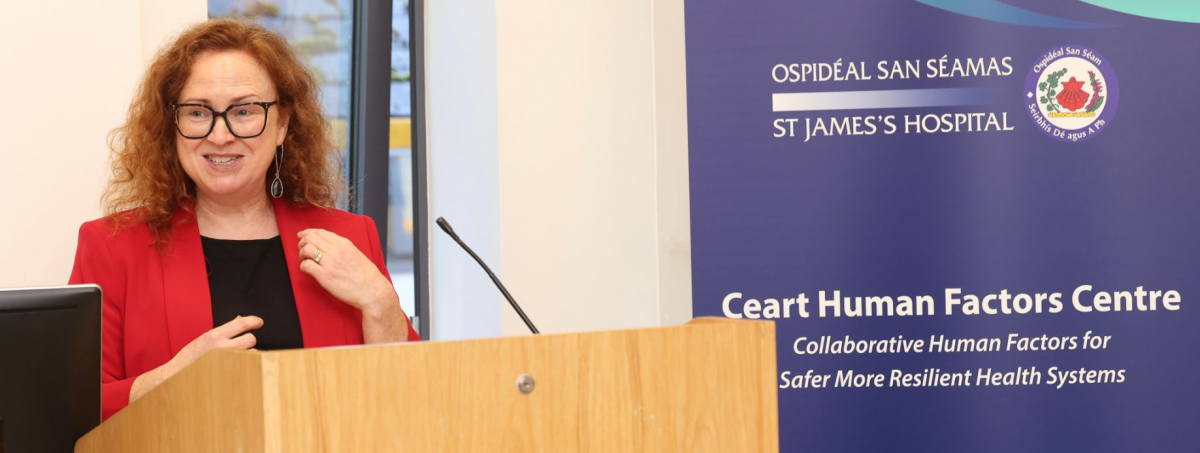
St James’s Hospital has launched Ceart, a dedicated Human Factors Centre intended to make healthcare systems safer and better suited to the needs of patients and staff. The initiative brings patients, clinicians, researchers and educators together to translate human-factors research into practical improvements in patient safety, care quality and staff wellbeing. Health Manager Journal reported the launch on 4 November 2026, describing Ceart as Ireland’s first Human Factors Centre established and led by a hospital.
Led by Prof. Marie Ward, the centre builds on the hospital’s work in health systems research and quality improvement. The Patient Safety Movement Foundation’s profile of Prof. Ward identifies her role in human-factors research and improvement at St James’s, as well as her academic work in the field. Her experience provides an established research foundation for Ceart’s ambition to connect evidence with everyday clinical practice.
The initiative has a clear health and safety focus. Human factors examines how people interact with equipment, technology, processes, teams and their working environments. Applying these principles can help organisations understand why risks emerge and how systems can be redesigned to support safer decisions and more reliable care. The HSE’s human-factors guidance identifies the discipline as an important contributor to improving safety, quality and efficiency in healthcare.
St James’s Hospital CEO Prof. Mary Day credited Prof. Una Geary and the Quality and Safety Improvement Directorate with recognising the role human factors can play in improving outcomes for patients and staff. In the comments reproduced by Health Manager Journal, Day also connected the centre with the hospital’s Academic Health Science Centre ambition to turn research and innovation into improvements in patient care.
The research underpinning this approach is already visible in published work. A 2025 study involving Prof. Ward and colleagues examined how human-factors methods supported a redesigned approach to antibiotic allergy de-labelling in an intensive care unit. The researchers reported that 85 patients with reported non-immune or low-risk antibiotic allergies were successfully de-labelled. The study illustrates how understanding the wider clinical system and involving relevant teams can support changes in practice.
For hospitals, the opportunity extends across clinical workflows, communication, equipment use, infection prevention and the design of working environments. Ceart provides a dedicated structure through which these issues can be examined collaboratively, with patient and staff perspectives informing improvement work. Its longer-term contribution will depend on how research is translated into measurable changes and shared across healthcare services.
For the sector, the lesson is direct: patient and staff safety improve when healthcare systems are designed with people in mind. By bringing research, clinical expertise and lived experience together, Ceart creates a platform for practical safety improvements and stronger learning across Irish healthcare.
Source: Health Manager Journal, Ireland’s first Human Factors Centre Launched













.png)
