

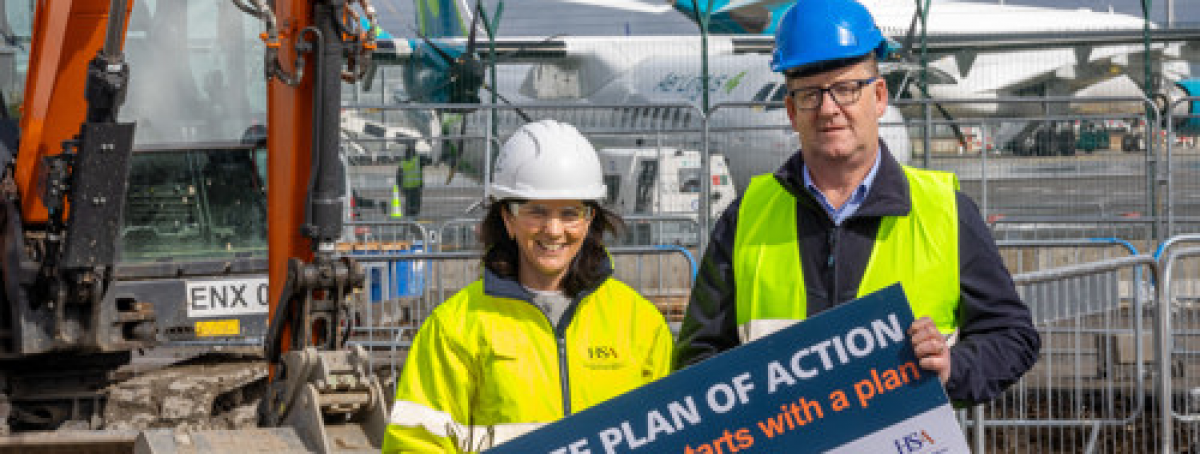
Safety planning on Irish construction sites has taken a practical step forward in 2026. The HSA, in collaboration with the Construction Safety Partnership Advisory Committee, has launched the Safe Plan of Action, an A3 one-page tool to help any crew prepare to work safely at the start of each day. The SPA translates safety documentation into clear, actionable steps, making daily planning accessible to every crew on every site.
The SPA is a model of what safety innovation looks like at its best: simple, practical and grounded in daily site reality. It sits alongside Risk Assessment Method Statements, bridging the gap between documentation and action that safety professionals have long identified as a critical failure point. Three qualities make it a significant contribution to Irish construction safety culture: universality across site types and crew sizes, accessibility for multilingual workforces, and direct support for the legal duties of the Project Supervisor Construction Stage.
The SPA functions as a daily planning document any crew can complete before work begins. It prompts supervisors to identify hazards, confirm controls and verify that all crew members have understood the safety briefing. Dedicated space for noting the languages used in briefings and confirming that interpreters have been deployed addresses one of the most significant risks on modern Irish sites: communication failure on diverse crews. This makes it one of the most inclusive safety planning tools produced for Irish construction.
The SPA is a deliverable within the CSPAC Construction Safety Action Plan 2025–2027, committing the HSA, the CIF, trade unions and industry bodies to standardising good practice. It supports the duties of the Project Supervisor Construction Stage under the Safety, Health and Welfare at Work (Construction) Regulations 2013, giving PSCS duty holders a practical instrument for coordinating health and safety across sites of every scale.
The SPA’s design reflects a clear understanding of where safety gaps are acute. Many serious incidents on Irish sites involve small contractors and the self-employed, who typically lack the infrastructure of larger operators. The SPA gives those operators structured daily planning without requiring specialist knowledge. EU-OSHA research identifies pre-task planning as among the most effective behavioural interventions for small and medium enterprises in construction.
Three practical steps allow construction leaders to maximise the SPA’s value. First, adopt it as standard practice on every site, integrating it into toolbox talk routines so completion becomes a natural part of how crews begin each day. Second, brief project supervisors on its relationship to RAMS documentation and PSCS obligations. Third, use the multilingual briefing feature actively on diverse sites, treating it as a communication assurance mechanism rather than a supplementary option.
The Safe Plan of Action demonstrates that the most effective safety tools are often the most straightforward. By condensing daily pre-task planning into a single A3 page, the HSA and CSPAC have produced a scalable instrument that works for a two-person subcontractor and a large principal contractor alike. Leaders who embed it consistently will find it builds the daily habits that define genuine safety culture.
(The views expressed by the writer are his/her own and do not necessarily reflect the views or positions of BusinessRiver.)







.png)
